| 7.1 The Effect of Nuclear Resonances on LAD Data |

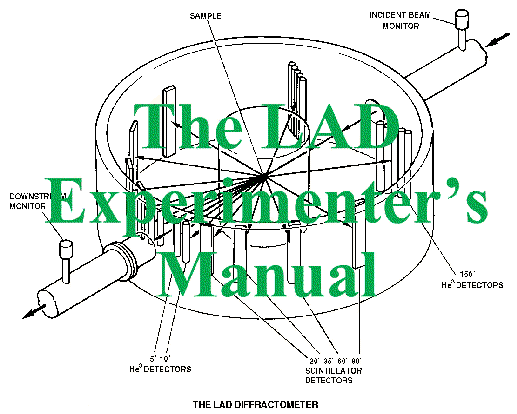
It is quite common for nuclei to strongly absorb neutrons over a small range in neutron energy due to nuclear interactions. The energy value for the centre of such an absorption peak is termed the resonance energy, and approximately half of the elements in the periodic table have one or more isotopes with at least one resonance energy within the range covered by LAD. The effect of nuclear resonances on a time-of-flight diffraction spectrum is to ‘take a bite’ out of the data over a range of neutron energy centred on the resonance energy. The effect of absorption in this region is very strong, and it is not possible to successfully correct the data which are affected by the resonance. Hence the affected region of the data must be omitted in the final analysis. However, it is still possible in almost all cases to extract a structure factor S(Q) which does not have gaps in it where the resonance-affected data have been omitted: The nuclear resonance occurs at constant energy which means that it occurs at a different value of Q for each scattering angle. Hence the resonance produces a gap which covers a different range in Q for the structure factor measured by each detector bank. It is thus possible to combine the data from the different detector banks to produce a structure factor which covers the full range of the instrument without any gaps. This ability to overcome the effect of nuclear resonances is a consequence of the wide angular coverage given by LAD. There is, however, an additional problem with resonances for LAD data because the scintillator detectors (at scattering angles of 20°, 35°, 60° and 90°) are sensitive to gamma rays. Many nuclear resonances involve the emission of a prompt gamma ray when the neutron is absorbed. Thus the sample emits a flash of gamma rays at the point in time when the resonant neutrons arrive at the sample. Since gamma rays travel very much faster than neutrons this results in a peak being observed in the LAD scintillator detectors at an earlier time-of-flight than the ‘bite’ due to the neutron absorption. The usual signal in the LAD scintillator detectors for a neutron resonance is thus a dip at lower Q followed closely by a peak at higher Q. The LAD gas detectors have an extremely low sensitivity to gamma rays and hence the peak due to prompt gammas is not observed.
In a few cases the gamma sensitivity of the LAD scintillator detectors can lead to a further problem in addition to producing a peak from the prompt gamma flash. It is possible for the neutron absorption to leave the nucleus concerned in an excited state which then emits a delayed gamma when it decays. If the lifetime of this excited state is roughly the same as the length of a time-of-flight frame (i.e. 20,000 m seconds) then the delayed gammas give rise to an approximately time-independent background signal in the data from the scintillator detectors, which appears as a strong rise at low Q. Thus far this problem has only been observed for isotopes of silver. However, a flat-background subtraction program is available from Alex Hannon which is able to significantly ameliorate this problem when performing a full analysis of the data.
A comprehensive tabulation of the nuclear resonances likely to affect diffraction data on LAD is given in Appendix E of the ATLAS manual [2].
A program is available for calculating the Q-values which are affected by a particular resonance for each LAD detector bank. This is run by typing RUN G_F:RES . The user is prompted for the resonance energy (note that this must be given in units of meV, although resonance energies are usually tabulated in units of eV). The following output is then produced:
LAD> run g_f:res
******************************************
* RES : Calc effective positions of resonance for LAD *
* Alex Hannon 17-12-90 *
******************************************Give resonance energy in meV > 1000
E = 1000.00 meV
k = 21.9703 inverse Angstroms
Units: degrees, inverse Angstroms
Qn=position of neutron dip
Qg=position of gamma peak
For 2theta = 145.00 Qn = 41.9070 Qg = 46.6341
For 2theta = 90.00 Qn = 31.0707 Qg = 34.2990
For 2theta = 60.00 Qn = 21.9703 Qg = 24.2684
For 2theta = 35.00 Qn = 13.2132 Qg = 14.5914
For 2theta = 20.00 Qn = 7.63022 Qg = 8.42376
For 2theta = 10.00 Qn = 3.82968 Qg = 4.23065
For 2theta = 5.00 Qn = 1.91666 Qg = 2.11466
Results in file RES.LIS
FORTRAN STOP
LAD>



Last Updated 09 Nov 1998