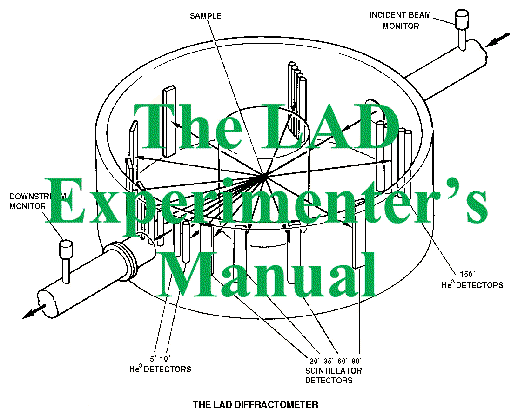
| 3.3 Sample Tank Vacuum System |

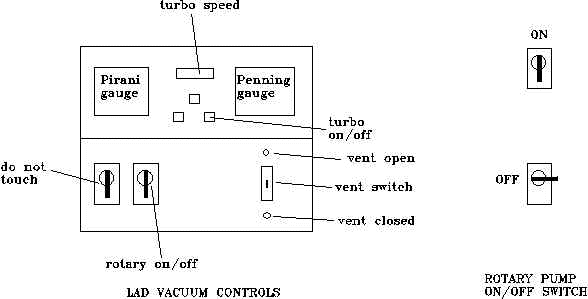
The LAD sample tank is evacuated by both a rotary pump and a turbo pump located directly under the tank. The controls for these are situated in the top of the rack to the right of the interlocked gate. The top rack contains the two gauges for the tank: a Pirani and a Penning. The Penning gauge would be damaged if it were turned on whilst there was a significant air pressure in the sample tank and hence it is automatically switched on or off by the Pirani gauge when it reaches a preset value of about 1 mbar.
In most cases the sample tank vacuum is let up to air by opening a manual valve on the SE equipment flange. With some items this is not possible, eg furnaces and Orange cryostat. In this case air can be admitted by opening an electromagnetic vent located underneath the instrument. This vent is controlled with the 'fish' key (key number 5) which is kept in the key press in the LAD cabin. The state of the vent is indicated by the red and green lights. Of course it is essential that the vent be closed when not in use. It takes considerably longer for the sample tank to reach atmospheric pressure when the vent is used, and thus the use of a manual valve on the SE equipment flange is generally to be preferred.
The sample tank should normally be evacuated during a neutron experiment in order to eliminate the effects of air scattering. This may be done as follows:
Check that the electromagnetic vent and the manual valve on the SE equipment flange are both closed.
Switch on the rotary pump.
Wait for the pressure on the Pirani gauge to reach a value of about 5 mbar. This will take a small number of minutes.
Turn on the turbo pump.
When using the candle-stick (see section 6.2) a final pressure in the region of 10-4 mbar should be achieved if both rotary and turbo pumps are used. However, a pressure of 1 mbar is sufficiently low for the effects of air scattering on the neutron diffraction data to be negligible. The procedure for admitting air to the sample tank is as follows:
Switch off the rotary pump and the turbo pump.
Open the manual valve or electromagnetic vent. (It is not necessary to wait before doing this.)
It is important that the turbo pump is not turned on when there is a significant pressure of air in the sample tank because it is unlikely that it will start successfully. There is a needle gauge between the Pirani and Penning gauges which indicates the speed of rotation of the turbo pump. In normal operation the turbo pump should be rotating at full speed. If it does not reach maximum speed after a short time then this indicates a problem, one possibility being a vacuum leak. However, note that when the turbo pump switch is set to off the needle gauge immediately goes to zero because the turbo pump rotation speed is no longer being measured, not because the turbo pump has immediately ceased to rotate. Occasionally it may be necessary to press some combination of the three turbo pump buttons in order to re-start it, but normally the other two buttons should not be touched.



Last Updated 09 Nov 1998